
Vancouver Mold Remediation
Prolonged cool, humid winters in Clark County keep indoor relative humidity elevated, allowing active mold colonies to thrive on damp building materials within 48 to 72 hours. Our certified remediation specialists deploy commercial containment and rapid drying to protect your property and indoor air quality. Contact our local emergency dispatch team today to restore safety to your home.
Call (360) 555-0147 if water is standing right now.
Prefer to talk? (360) 555-0147
Clark County Structural Restoration Specialists
Our certified technicians treat every mold outbreak as an urgent structural and air quality issue.
When property owners face sudden flooding, they can rely on our emergency water damage restoration specialists to eliminate moisture before spores colonize.
About 54% of housing units locally (43,918 of 80,754) were built before 1980, the period when asbestos-containing materials and lead paint were still in use.
Because the median owner-occupied home locally was built in 1986 (Census ACS 5-year), modern remediation requires strict safety protocols around older building envelopes.
Homeowners often describe how ground moisture rising from unsealed crawl spaces elevates indoor humidity and feeds mold growth, triggering severe respiratory issues.
A pattern echoed in public discussions is that surface-level dryouts fail when hidden foundation wall cracks and unaddressed secondary intrusion points are left uninspected.
We conduct thorough structural moisture mapping on every project to guarantee no hidden dampness escapes remediation.
Step-by-Step Moisture & Mold Remediation
Mopping up indoor flood water without commercial air movers and dehumidifiers results in active mold colonies spreading behind drywall and beneath flooring. Following heavy seasonal weather, property owners who address severe exterior storm damage promptly prevent invasive water from saturating wall cavities. Our systematic protocol removes active growth, extracts bound moisture, and purifies indoor air.
- Comprehensive Thermal Inspection. Our technicians utilize infrared cameras and calibrated moisture meters to pinpoint active moisture reservoirs and hidden fungal growth behind walls without invasive demolition.
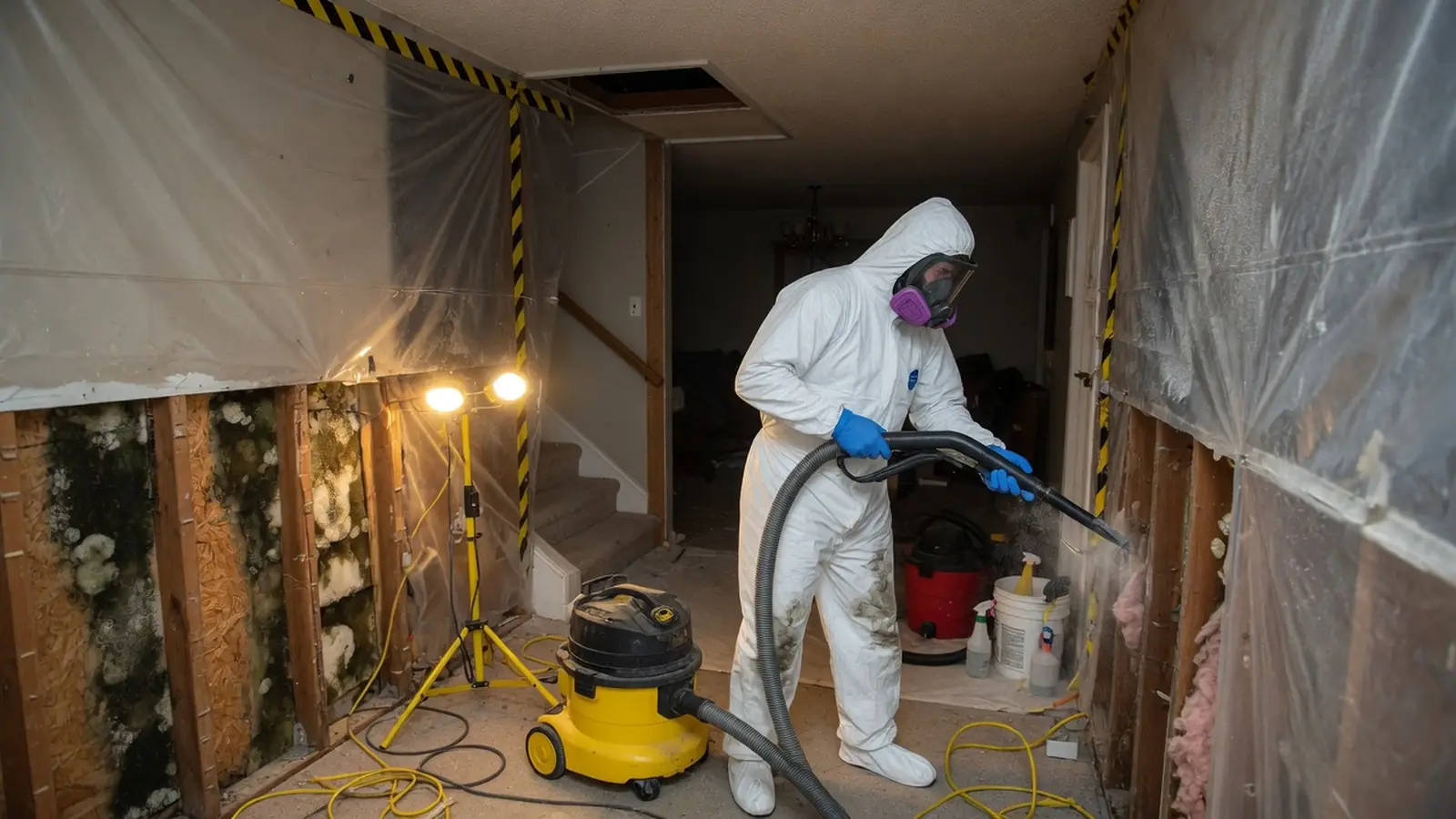
- Negative Pressure Isolation. Technicians isolate contaminated rooms with sealed polyethylene barriers and HEPA-filtered air scrubbers under negative pressure so spores cannot escape into clean living zones. Critical barriers prevent cross-contamination to unaffected living spaces while exhaust ducting routes scrubbed air outdoors.
- Material Removal & HEPA Remediation. Unsalvageable porous components are safely bagged and removed, while structural timbers undergo HEPA vacuuming, mechanical sanding, and hospital-grade botanical antimicrobial treatment.
- Structural Dehumidification & Testing. Commercial low-grain refrigerant dehumidifiers extract residual moisture from structural framing until moisture readings meet dry standards, followed by post-remediation verification.
Certified Workmanship & Lasting Protection
We never perform superficial cleanups that leave hidden fungal reservoirs behind. If an untreated crawl space is feeding moisture up through the building envelope, we coordinate to resolve wet crawl space conditions completely. Our commitment ensures every moisture source is sealed and sanitized across Felida, Salmon Creek, Hazel Dell, Cascade Park, Fisher's Landing, Minnehaha, Orchards, and Downtown properties.
Attic Mold Remediation
Winter attic condensation combined with inadequate soffit ventilation leads to widespread mold blooms across structural roof sheathing. Our team inspects the underside of roof decking, corrects airflow blockages, and applies professional antimicrobials to eradicate the colony. We safeguard your structural lumber from progressive dry rot and seasonal spore release.
Exhaust Vent & Deck Sanitization
Faulty bathroom exhaust venting releases warm, humid air directly into attics, generating extensive mold growth across the underside of the roof deck. We reroute compromised ducting outside, replace moisture-damaged insulation, and remediate affected framing. This targeted restoration halts recurrent humidity cycles that threaten your home.
Crawl Space & Subfloor Treatment
Persistent ground humidity and foundation seepage foster aggressive mold colonies that weaken floor joists and deteriorate indoor air. We extract damp insulation, scrub structural subflooring, and treat all crawl space timbers with long-lasting antifungal barriers. Our thorough methods protect your family from rising airborne contaminants.
Our Commitment To Scientific Remediation
Every remediation project follows rigorous IICRC S520 guidelines to ensure indoor environments are thoroughly restored to baseline health. We focus on transparent diagnostics, complete spore containment, and documented moisture verification across our entire regional territory.
- 11Zip Codes Served
- 8Service Areas
- 3Services Offered
Local property owners depend on our certified specialists when unexpected moisture and fungal outbreaks threaten their homes. Here is what residents have to say about our meticulous containment, rapid response, and transparent approach to structural restoration.
“While pulling back water-damaged drywall in our laundry room, the crew discovered extensive fungal growth stretching along the structural rim joist. They calmly explained the issue, adjusted their containment barriers immediately, and treated the hidden timber without escalating our stress. Their quick composure turned what could have been a nightmare into a routine, professional fix.”
Marcus H.
“Our home sale was nearly derailed when an attic inspection flagged mold decking just four days before closing. The team mobilized within hours, set up continuous air scrubbers, and completed full treatment in time for the reinspection to pass seamlessly. Thanks to their prompt execution, our buyers signed off and the transaction closed right on schedule.”
Elena R.
“A previous handyman tried to wipe out our crawl space mold with regular store bleach, leaving behind warped subflooring and an intolerable chemical odor. These technicians came in, properly contained the contaminated zone, and physically extracted the embedded spores using certified HEPA equipment. The difference in air quality throughout our home was noticeable almost immediately.”
Derrick K.
“Receiving a comprehensive written estimate before any work started gave us complete peace of mind during a stressful discovery. The crew stuck exactly to that initial scope, documented every stage of surface decontamination, and never added surprise fees to our final invoice. Knowing the exact investment upfront made hiring them an effortless decision.”
Claire T.
Frequently Asked Questions
How long does professional mold remediation typically take?
Most residential remediation projects require between one and three days depending on moisture depth and containment scope. Air scrubbers run continuously throughout the cleanup, and clearance testing verifies spore counts return to baseline before equipment removal.
What factors determine the overall cost of mold remediation?
Remediation expenses depend primarily on the affected square footage, material porosity, and structural drying equipment. Removing drywall or crawl space insulation increases labor, while localized surface treatments on solid timber remain more affordable.
How do you prevent mold spores from spreading to clean rooms?
Specialists install heavy polyethylene barriers and run commercial HEPA air scrubbers under continuous negative air pressure. This setup pulls air inward toward the contaminated space while exhausting scrubbed air safely out through dedicated exterior ducting.
Can surface mold on porous materials like drywall and framing lumber be neutralized with household bleach instead of professional removal?
Bleach cannot neutralize mold on porous materials because its water base feeds fungal roots while chlorine evaporates on the surface. Porous drywall requires physical removal, whereas framing lumber requires HEPA sanding, antimicrobial wash, and penetrating sealant.
What local weather conditions cause recurring attic mold blooms?
Winter temperature drops combined with high regional humidity trigger heavy condensation along uninsulated structural roof sheathing. When bathroom fans discharge into attics or soffit vents become blocked, trapped moisture generates widespread deck mold within weeks.